23 feb 2013

Create without destroying: Carmina Campus, a fashion sustainable initiative


These are the days of the Milan Fashion Week, one of the things that has attracted the attention of Sustainable diary is Carmina Campus, a collection of handbags, jewels and furniture successfully combining the idea of ethical fashion and sustainable eco-friendly, with the great traditional Italian craftsmanship.
The brand was founded in 2006 by Ilaria Venturini Fendi, who explains "With Carmina Campus I tried to fashion a new approach, enriching the body of knowledge derived from my family history with values such as respect for the environment and the implementation of work projects aimed at social development"

The creations included in the collections are under the sign of reuse and upcycle, as Carbags line, bags made with seat covers, sun screens, safety belts recovered from car in shambles. Over the years the collection Carmina Campus made in Italy has been enriched by new materials. So switches are turned into sparkling Switch Bag and bottle caps become closures for Pyramid Bag, bags reversible with an inlay made of small pieces of leather processed in a pyramid. And then there are the old color charts, which take the form of soft Soft Bag.


While the items of the collection 100% made in Africa, successfully making concrete the philosophy “not charity, just work”. In Kenia Carmina Campus has given rise to the Ethical Fashion Initiative. The project has seen the involvement of some employees of craftsmen who have passed on their know-how to local communities through a process of training on site. So the brand has launched social projects that have the objective of training microentrepreneurs, promoting education and health care. The iniative was born from the collaboration of Carmina Campus with ITC (International Trade Centre), an agency of the UN and the World Trade Organization, whose mission is to provide developing countries opportunities for training and work.

More info

Photo credit © Carmina Campus


22 feb 2013

10-meter high of Plastic Bags, by Pascale Marthine Tayou


The installation Plastic Bags occupies since last spring, the Hall of the historic part of the MACRO - the Museum of Contemporary Art of Rome, interacting with the Odile Decq's architecture. This is the space for free passage of MACRO, which is used by the locals to move from one street to another district, just like a square from the global village.

Plastic Bags is a large installation shaped like a giant beehive, almost ten meters high by the Cameroon artist Pascale Marthine Tayou. It is made entirely from plastic bags that evoke in their simplicity, the many stories of our daily lives. They offers a colorful critique of capitalism, consumerism and widespread plastic pollution.
Everyday objects, useful as insidious, the bags have become a symbol of the growing globalization and consumerism, but also homelessness that increasingly characterizes today's society, a central theme in the artist's research.
But the journey of these plastic bags was long. In 2012 the installation was realized at gare de Paris Saint Lazare with the collaboration of the people. The work was in 2011 in Milan at Hangar Bicocca for the group exhibition "Terre Vulnerabili", and even before at Queensland Art Gallery of Brisbane, in Australia.

The common denominator of his work is the idea of travel, not only physical but also mental, that manifests itself as an ongoing cultural and geographic displacement also in the choice of materials (waste and rubble urban or everyday objects often coming from the place where he is to work). The traveler for the artist is not only a way of life, but also a psychological condition, meeting with something else, able to subvert the social, the political, economic and symbolic of our life: "It is a certainty that traveling is the hope of meeting the magic that hides the mysteries of the rational human being."

Plastic Bags will be on exhibit at Macro through April 1, 2013.

More info
website MACRO

Photo credit © Giorgio Benni/MACRO


21 feb 2013

Urban agriculture on ship in Antwerp, by art collective Time Circus


In this day of snow in Milan, is back again to talk about urban garden, this time the project enters (or leaving?) directly from the art world.
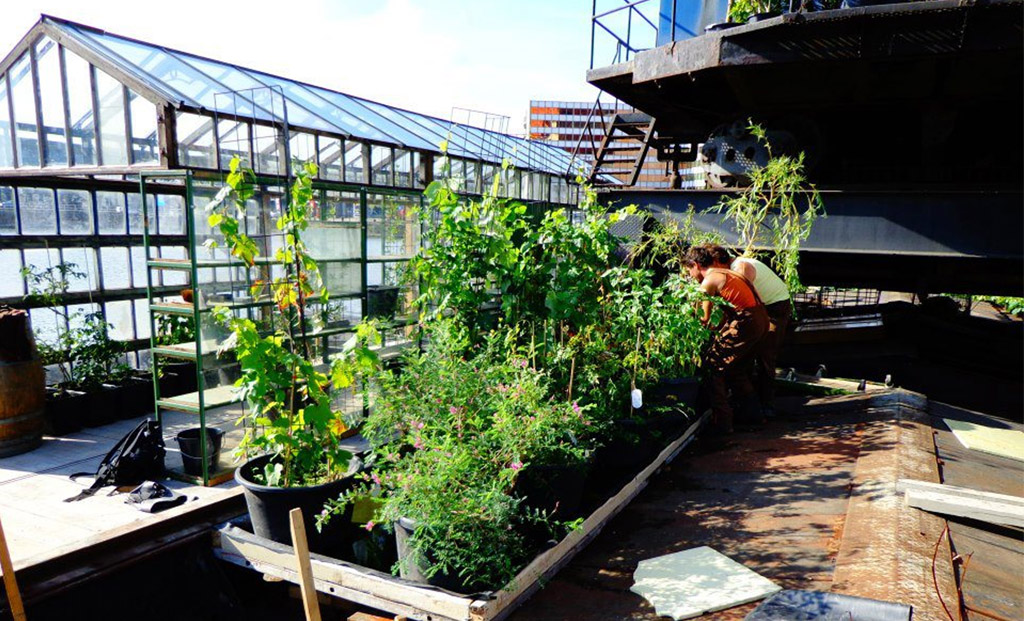
We know that urban gardens can bloom in the weirdest of places, also on an old unused ship crane docked at Bonapartedok, the Belgian port city of Antwerp. Here the Belgian art collective Time Circus, built their great green space, and outfitted with a tree-house made out of recycled materials and a chicken coop. Another cute feature from the floating garden is a glazed greenhouse.


Commissioned by the Antwerp’s MAS Museum, the floating Welvaert Welton garden is designed to engage locals and visitors with sustainable urban farming practices, through community workshops on composting and homemade cider parties. Not only is there a vegetable garden, there's also a kitchen where food can be prepared using ingredients straight from the garden. Urban agriculture is not just about producing one’s own vegetables but more about creating an urban living, working and meeting place.

This experimental garden project is temporary, intended to go on until 2014. It is one cool example of taking back abandoned city spaces, and they can become green and productive.
Time Circus said that is ready to travel to far off places to spread the idea...

More info

Photo credit © Time Circus


20 feb 2013

Walkonomics mobile app, walking forward in the 21st Century


After talking for two days of food sustainability (monday, tuesday) now it's time to go for a nice walk. The quality and amount of walking as an everyday activity, in any given area, is an established and unique primary indicator of the quality of life. And when I read yesterday of the launch of the new Walkonomics app for iPhone and iPad I thought that was a fantastic development after the Android version. The free Walkonomics mobile app maps and rates the pedestrian-friendliness of every street in San Francisco, New York and England, yes we miss Milan and the rest of the world but let's hope it will arrive in the soon future.

Walkonomics provides 5 star ratings for each street in the following 8 main criteria:
Road safety: How safe do you feel from traffic on this street? It is influenced by actual road accident statistics (where available), street type, traffic speeds and activity.

Easy to cross: How easy it is to cross the street at regular points along the street? It is influenced by the traffic activity on the street, street width, physical barriers and provision of pedestrian crossings.


Pavements /Sidewalks: Are pavements/sidewalks provided along the street? Are they high quality? Are they wide enough? Do they have a lot of unnecessary clutter/furniture on them? Are they overcrowded?

Hilliness: Is the street flat or on a hill? How steep is any slope? If the street is steep, then are any hand-rails or seats provided?

Navigation: How easy is it to find your way around in this street and area? Is it easy to become lost here? Are any street names, pedestrian signs or maps provided?

Fear of crime: How safe do you feel from crime on this street? It is influenced by actual crime statistics (where available) as well as perceived fear or crime. Other factors include lighting, vandalism, graffiti and presence of police.

Smart and beautiful: How clean is the street? Is there much litter or vandalism? Is it regularly cleaned? Does the street have any trees or other green vegetation? Are the buildings attractive and in good condition?

Fun and relaxing: Is this a fun, interesting and popular place to be? Are there things to do in this street? Would you choose to spend time and hang-out here? Does the street have a relaxing atmosphere? Is it noisy or stressful? Can you play in this street?

Walkonomics app shows promise, we have just to wait until they expand coverage!
For the moment if you are a luck one based in New York City, San Francisco or in the UK you can get the new Walkonomics iPhone app here and for Android here.

More info
website Walkonomics

Photo credit © Walkonomics


Twitter Delicious Facebook Digg Stumbleupon Favorites More