Visualizzazione post con etichetta Eco on budget. Mostra tutti i post

17 mar 2013

Sunday's tale: Bottle Masonry. Made house with recycled plastic bottles


Sunday's Tale: a post from the past
On Sustainable diary last Sunday we spoke about an amazing building made with glass bottles, and also today we decide to tell a bottle’s story.

Plastic bottle construction is an idea of Andreas Froese, an architect and environmental entrepreneur. Froese developed Eco-Tec, a method to utilize plastic (PET) bottles as “bricks” in the construction of houses, latrines, and water tanks. It is a good idea to address the problem by putting to use some of the million plastic water bottles discards each day in developing nations.

The first plastic bottle construction project in Africa was pioneered in Uganda by an organization called Butakoola Village Association forDevelopment - BUVAD. BUVAD is located in Kayunga, a district north of Kampala.
They teamed up with Eco-Tec to bring bottle construction technology to Uganda in the form of a latrine block. Students and community members at a local primary school collected and filled bottles found throughout the community and together they built a block of latrines for their school. Constructed in April 2010, BUVAD’s latrine block was the first of its kind on the continent.


Benefits of Bottle Construction
Waste management - A small house can use as many as 10,000 bottles, waste that would otherwise be deposited in a landfill or burned.
Environmental protection - Unlike “traditional” bricks, bottle bricks are not fired, a process which uses much firewood and contributes to deforestation.
Cost effective - Building with bottles is typically less expensive than building with bricks as the main construction material is trash.
Job creation – The construction process of building with bottles is work intensive. This means many can be involved in the process, creating opportunities for employment and community involvement, from collecting to filling to building. While this method would potentially be costly in more industrialized nations, where labor is expensive and materials are cheap, in countries like Uganda, materials are expensive, labor is cheap, and jobs are in demand.
Shock resistant – The plastic coating of “bottle bricks” makes them more flexible than fired bricks. Bottle construction has greater shock resistance and is well suited for earthquake prone areas.
Long lasting – It is estimated that it takes a plastic bottle approximately 300 years to decompose.

Here you can have a tutorial, and here you can find some inspirations.

More info
website Eco-Tec

Photo credit © Aminu Abubakar

16 mar 2013

Buffalo Project: on-demand mobile electricity. A simple and unique solution


In recent years mobile phone communication has been a major contributor to economic growth in developing countries but its spread has been hindered by limited charging options for the 650 million off-grid mobile phone users who have network access.
Having an operational phone means access to services that have improved banking, health and farming in Africa and Asia. Many millions of people at the bottom of the economic pyramid are expected to acquire mobile phones, greatly benefiting their lives, business activities and access to information. However, most of these new subscribers will not have direct access to electricity.


In response to the growing problem, London-based Buffalo Grid have developed a text message activated solar-powered cellphone charging station to help cut electricity costs. The technology utilizes a 60-watt photo-voltaic panel, which charges a battery that is then taken to the village on the back of a bicycle. The portable micro generator extracts power from the harvested solar energy using a technique called maximum power point tracking (MPPT) - providing on-demand mobile electricity. The system is activated when a customer sends a text message to the device. Once the message is received, an LED above a socket on the battery lights up, indicating that it is ready to charge a phone. On average, each text message allows a phone to be charged for 1.5 hours; where a fully charged 'buffalo grid' unit can last for three days, with up to 10 charging points and charge 30 to 50 phones per day.

In addition to this, Buffalo provides environmental benefits through supplying zero CO2 power which translates into increased access to safe lighting. The system can also be used to provide off-grid power for a range of uses from medical to educational applications.
It will help in bringing a considerable amount of economic growth to hundreds of rural communities around the world.

More info
facebook page

Photo credit © Buffalo Grid
Buffalo entrepreneur, Bududa village, Uganda


15 mar 2013

Indonesian students create eco-friendly deodorant from cow dung


DwiNailul Izzah and Rintya Aprianti Miki are two students who won the gold medal at the Indonesian Science Project Olympiad (ISPO), which is held every year at the end of February in Jakarta, with their original invention and respectful of environment.

The two young inventors have create an affordable air freshener made from cow dung. Yes dung, as weird as it sounds, the formulation actually has a pleasant herbal smell. This two girls overcame 1,000 other competitors with their surprising freshener, which was created by collecting unused cow manure from a cattle farm in Lamongam, East Java, and fermenting it for 3 days: "Then they extracted the water from the fermented manure and mixed it with coconut water. Finally, they distilled the liquid to eliminate all impurities. The whole process took 7 days, which is pretty long, but in the end they obtained what they were looking for – a liquid air freshener with an herbal aroma from digested cow food."

Their natural deodorant is healthier, contains no chemicals that are found in similar products available on the market, and is also cheaper. While a traditional deodorant to 275 grams costs 39,000 Indonesian rupiahs (about $ 4), a 225-gram cans of deodorant from cow dung only costs 21,000 rupees (about $ 2), which is half. Explains Dwi Nailul Izzah: "Our air freshener is not supplemented with chemicals to smell fragrant, it’s pure and smells like the natural plants fed to cows."

Dwi and Rintya are ready to show their cow poop air freshener at the International Environment Project Olympiad (INEPO) held in Istanbul, Turkey during May, and are going to file for a patent.

More info

10 mar 2013

Sunday's tale: the Thai Temple of recycled beer bottles


Sunday's Tale: a post from the past
In the Thai landscape, Buddhist temples are very common sight.
Deep in Sisaket province, in the north-east of Thailand, lies one incredible temple complex. Its official name is Wat Pa Maha Chedi Kaew but it is known by almost everyone as Wat Lan Kuad or the Temple of a Million Bottles
There’s an estimated 1.5 million bottles bound in concrete into the temple. It is a novel way to recycle any empties.

The construction of this temple complex began in 1984, as the monks found themselves with an excess of donated beer bottles that they previously used just to decorate existing buildings.
The resident Buddhist monks at the complex encourage local authorities to deposit any used bottles at the temple which they then use to build new structures and works of art to the grounds of the temple. "The more bottles we get, the more buildings we make", says Abbot San Kataboonyo. Everything on the temple site, from the crematorium to the toilets, incorporates the bottles, making a space that’s both functional and beautiful. Bottle caps have been used to decorate murals, and to create mosaics of Buddha.


The monks have come to prefer the bottles over traditional red clay bricks as they don’t fade and produce a fantastic colored ambient light. They primarily use green and brown glass bottles from the beer brands Heineken and Chang. Some of the older buildings in the complex are created with rare square shaped Heineken bottles that are easily stackable and were briefly sold in the 80′s. Perhaps that is where the idea for bottles as bricks was originally conceived.

Even though drinking is a sin in Buddhism, this still seems like a positive use of beer and lager bottle. So, if you find yourself in Thailands Sisaket province consider stopping by and earning some merit. Or at least just enjoy a cold beer and donate your bottle to the effort!


8 mar 2013

Starving Artists Project tells the stories of homeless artists

Despite their massive presence, the homeless are widely ignored. They are part of city invisible culture. But every day this people communicate to us, telling their basic need for help through a piece of cardboard. Each sign expresses a basic human need in a creative way completely unique to the creator’s life.

StarvingArtists Project is a new initiative, it try to change all of that by giving NYC’s homeless community a platform to showcase their cries for help. The program seeks to turn the cardboard signs we see being held up on street corners and in subway stations into art that funds social change.
The creators of the project, Nick Zafonte and Thompson Harrell, worked with world-renowned photographer Andrew Zuckerman (famous for shooting portraits of politicians, humanitarians, artists and entertainers) to capture beautiful, dignified portraits of each “artist” as well their handmade artistic signs and turn the images into a collection of art to inspire change.


The Starving Artists Project Film from Thompson Harrell on Vimeo.

The collection of diverse cardboard signs, along with portraits , debuted at the Dumbo Arts Center in January, 2012. The project showcases 35 handwritten signs, accompanied by portraits of the 30 artists who wrote them. A giant 4 ft tall collection cup was constructed and placed in the center of the gallery - all donations were given to the New York City Coalition Against Hunger and Holy Apostles SoupKitchen, two local charities focused on feeding the local community.
Zafonte and Harrell explained to the Huffington Post: “Everyday the homeless reach out through the only means they have, scraps of cardboard and their own creativity. The problem is we don’t ever look, seeing their messages as an interruption to our day. Our mission and solution was to change the way society interprets their messages – by presenting their signs as art, allowing their own voices to inspire meaningful action.”

More info

Photo credit © Starving Artists Project


27 feb 2013

A poetic concept: making bikes from junked cars

The Spanish design studio Lola Madrid, owned by creative agency Lowe & Partners, has launched few days ago the platform LOLA Hace (LOLA Make), in order to design and manufacture products that make life easier for people or emotionally in touch with them. The first product that they have conceived is Bicycled.
Bicycled is new making bikes project that utilizes recycled cars as the main source for material. It is such a poetic concept, fewer cars and more bikes is a probably a dream for cyclists everywhere, in an effort to create the most efficient, ecological and healthy means of transportation.

Even though the line is not yet complete, Lola Madrid has just launched a video about the process of transformation and creation of models: the exclusive use of car wrecks different gives a unique look to any bike, which makes anyone proud owns one! Each hand-made bike is based on a consumer insight - which reflects on the emotional attachment from wrecked vehicles. Body metal is used for the bike frame, brake lights turn into reflectors, door handles become seat post clamps and so on.


Bicycled looks like a great way to give cars a second life, while also reducing the demand for new material for bikes. Add in that each creation is closer to art than a mass produced product and they seem to have a winning combination.

More info
website Bicycled
website Lola Madrid

Photo credit © Lola Madrid


24 feb 2013

Sunday's tale - A portrait of happiness: Balloons of Bhutan by Jonathan Harris


Sunday's Tale: a post from the past
In Bhutan happiness is, no laughing, matter-academics study it, spreadsheets track it, billboards tout it, conferences debate it, and every year, foreign intellectuals flock to Thimphu to share their ideas about what exactly makes a person happy.
Instead of "Gross National Product" Bhutan uses "Gross National Happiness" to measure it socio-economic prosperity, essentially organizing its national agenda around the basic tenets of Buddhism. Bhutan's fourth king, Jigme Singe Wangchuck, invented the idea in 1972, to give his tiny country some international guard against potential future invasion by its two mighty neighbors (India and Chine).


Given the seriousness with which this topic is treated, Jonathan Harris thought it would be fun to do something a little be silly, so in late 2007, he spent two weeks in Bhutan, handing out baloons. He asked people 5 questions pertaining to happiness: what make them happy, what is their happiest memory, what is their favorite joke, what is their level of happiness between 1 and 10, and, if they could make one wish, what would it be. Based on each person's stated level of happiness, he inflated that number of balloons, so very happy people would be given 10 balloons and very sad people would be given only one (but hey, it's still a balloon).
They wrote each person's wish onto a balloon of their favorite color. He repeated this process for 117 different people, from all different ages and backgrounds. On the find night, all wish balloons were re-inflated and strung up at Dochula, a sacred mountain pass at 10.000 feet, leaving them to bob up and down in the wind, mingling with thousand of stands of prayer flags..

Jonathan Harris is an artist and storyteller, he makes projects that reimagine how humans relate to technology and to each other. Combining elements of computer science, anthropology, visual art and storytelling, his projects range from building the world’s largest time capsule (with Yahoo!) to documenting an Alaskan Eskimo whale hunt on the Arctic Ocean.

More info

Photo credit © J. Harris


21 feb 2013

Urban agriculture on ship in Antwerp, by art collective Time Circus


In this day of snow in Milan, is back again to talk about urban garden, this time the project enters (or leaving?) directly from the art world.
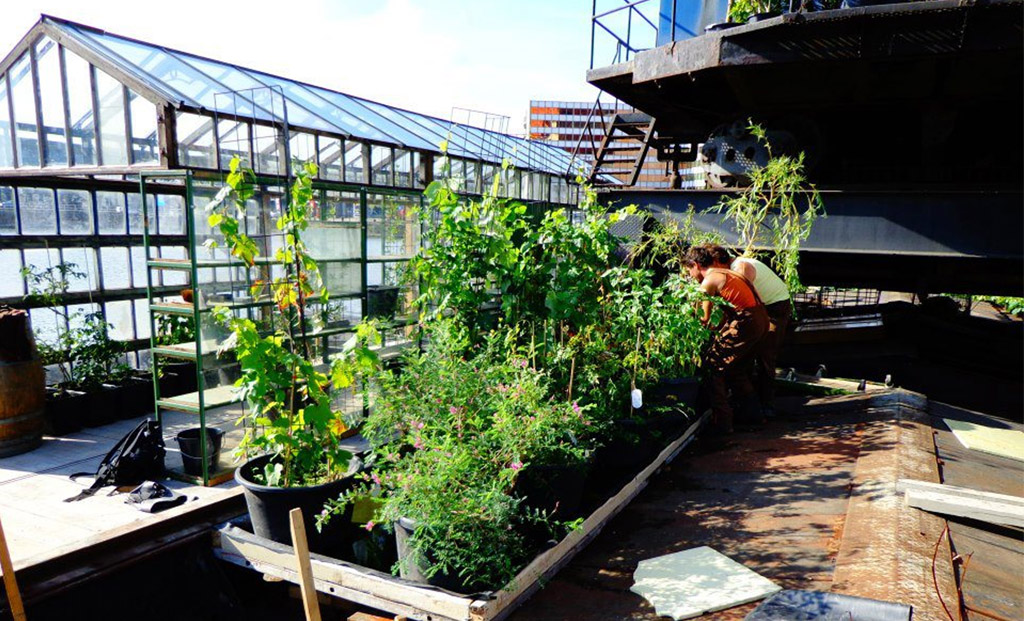
We know that urban gardens can bloom in the weirdest of places, also on an old unused ship crane docked at Bonapartedok, the Belgian port city of Antwerp. Here the Belgian art collective Time Circus, built their great green space, and outfitted with a tree-house made out of recycled materials and a chicken coop. Another cute feature from the floating garden is a glazed greenhouse.


Commissioned by the Antwerp’s MAS Museum, the floating Welvaert Welton garden is designed to engage locals and visitors with sustainable urban farming practices, through community workshops on composting and homemade cider parties. Not only is there a vegetable garden, there's also a kitchen where food can be prepared using ingredients straight from the garden. Urban agriculture is not just about producing one’s own vegetables but more about creating an urban living, working and meeting place.

This experimental garden project is temporary, intended to go on until 2014. It is one cool example of taking back abandoned city spaces, and they can become green and productive.
Time Circus said that is ready to travel to far off places to spread the idea...

More info

Photo credit © Time Circus


16 feb 2013

Upcycled Playground in Malawi's hospital by Sakaramenta


Sakaramenta is a social enterprise producing push and bicycle carts.
It is based in Blantyre, Malawi, and founded in 2009. Sakaramenta produces 5 different carts to transport patients, goods and other supplies behind the bicycle. The bicycle cars are designed according to high Dutch quality standards, at the moment 21 people are employed.

The reason to start up this business, is a believe in creating employment, stimulating entrepreneurship and local production in the best of way of bringing development to a country.
Getting things from A to B is not always easy in Malawi. The weather, shortage of fuel and quality of roads make carrying goods and people a though job. Sakaramenta takes the challenge to solve these problems.
Furthermore they make play ground, school and hospital equipment. Like glides, swings, school desks, trolleys. The focus point are: simple, strong and sustainable. All the parts can be maintained locally. Them workshop is in Blantyre, experienced and well educated staff are making high quality products.


The last project is born from an idea by Peter Meijer, founder and managing director of Sakaramenta. He has created a kids' playground on the site of a local hospital.
The simply wonderful intervention considers its site, introducing a scrapped ambulance, repurposing it as a playground clubhouse, with an integrated - where children patients (and grown-ups) can play having a fun together. Independent research concludes that playgrounds are among the most important environments for children outside the home. Most forms of play are essential for healthy development, but free, spontaneous play—the kind that occurs on playgrounds—is the most beneficial type of play.

More info

photo credit Sakaramenta


11 feb 2013

Baguette table by Studio Rygalik


Two days ago was pubblished a post about the start-up Culinary Misfits, today take again the topic "food waste" with Studio Rygalik of Warszawa, Poland.
They realized a new project, the starting point is a statistical fact: food thrown away in Vienna could feed half of the population of Graz. This was presented for the first time at the Vienna Design Week.
"It was also to show that the materials to build from are all around us. The tables were made from stale baguettes that were supposed to be thrown away".
These bread structures were part of a "bread experience" created by Gosia and Tomek Rygalik, the founders of the Studio, at the Design Week Laboratory, where people were surrounded by bread, eating bread dishes from bread tables.

In their series of "Baguette tables", they cut the french bread to varying lengths, their exposed ends leveled to create the table tops, the longer pieces providing support and stability, functioning as multiple legs, as well as providing some tasty, visual appeal.
Studio Rygalik aims to develop a wide variety of limited edition projects for companies, that maintain a good balance between the commercial and the experimental.


Studio Rygalik develops a wide variety of comprehensive projects. The focus is on furniture, products and spaces. The scope is wide – from design, development and implementation of new products to site-specific installations and production of limited editions, as well as objects, dining experiences and workshops that explore the relations of design, food and eating.

More info:

photo credits © Nick Albert /Kollektiv Fischka


Twitter Delicious Facebook Digg Stumbleupon Favorites More