Visualizzazione post con etichetta Local. Mostra tutti i post

18 mar 2013

Dabba wallas: 4,000 men and 175,000 lunches delivered. A sustainable food delivery system


Today Sustainable diary writes about the successful system of the Dabbawallas, who manage to deliver food from mothers and wives at home into the hands of their sons and husbands who are off at work. “Dabbawalla” comes from the term tiffin dabba, referring to a tiered lunch box and “walla,” a carrier or vendor.
This process, how you can see in the video, is complete sustainable.

"In India, where many traditions are being rapidly overturned as a result of globalization, the practice of eating a home-cooked meal for lunch lives on.
To achieve that in this sprawling urban amalgamation of an estimated 25 million people, where long commutes by train and bus are routine, Mumbai residents rely on an intricately organized, labor-intensive operation that puts some automated high-tech systems to shame. It manages to deliver tens of thousands of meals to workplaces all over the city with near-clockwork precision".
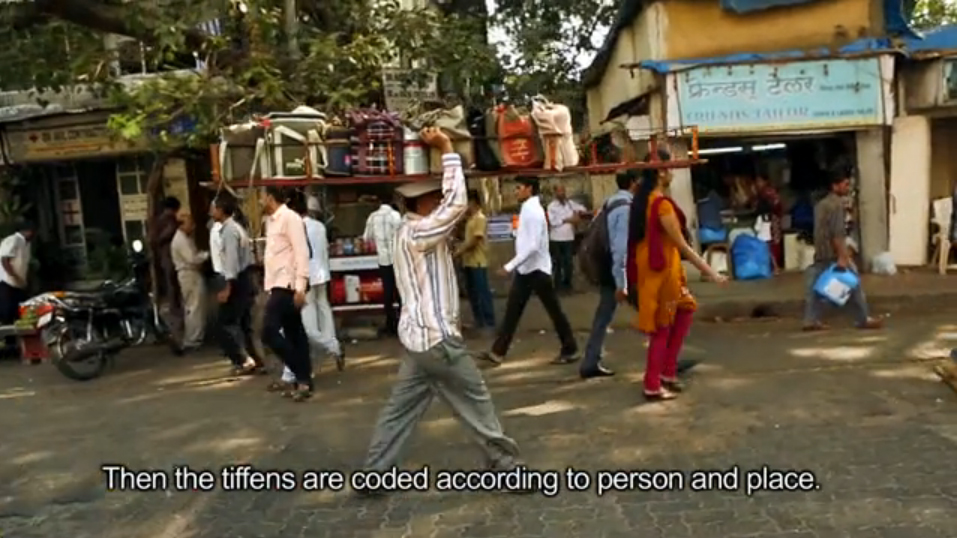

Dabbawallas's video is realized by The Perennial Plate, who explain: "Each day in Mumbai 4000 men in white outfits and matching hats transport 175,000 lunches across the big city. They retrieve the tiffens (lunch containers) of food from mothers and wives, and bring them (by foot, train, bicycle and even carried on top of their heads) to the office buildings of waiting husbands and sons. The Dabba wallas have been doing this since the late 1800s. Despite the unsophisticated mode of transport, the lunches always arrive on time (the error rate is 1 in every 16 million transactions). It's a pretty impressive feat and we were lucky enough to follow a couple Dabba Wallas for a day in Mumbai, and see their work first hand."

Despite the influx of food chains and eateries in Mumbai over the last decade, demand for the lunchtime service is higher than ever before, with customers from multinational corporations and hedge funds. If we thought it was too hard to have a hot, home-cooked meal for lunch each day, well, this organization proves us wrong.
More info


14 mar 2013

Waiting for the spring: Ecology of Colour Pavilion in Kent, UK


UK-based Studio Wave created Ecology of Colour, a colourful pavilion for holding a variety of sustainable craft workshops within Dartford Central Park’s Ecology Island. This is the third Artlands public realm commission for North Kent. Made from local materials, was designed “to act as a jolly custodian" and encourage community involvement in a neglected corner of a public park.

In response to this unique context, Studio Weave have designed a small versatile structure with a semi-outdoor space at ground level and an enclosed area on the first floor with many windows that open wide onto the landscape. As well for bird watching and art studio the building will be used as an outdoor classroom, a dyeing workshop and simply as a rain shelter, as well as sun shelter, within the Ecology Island.


The colorful cladding was conceived by graphic studio Nous Vous who have created a cohesive graphic visual language for the exterior of the building. Prior to its installation, a team of local residents and artists worked together in a painting workshop to produce each of the 144 panels, which form the external cladding.
The building opened in September 2012, now a group of designers is working with a group of horticulturists to create a garden full of native plants for extracting natural pigments (including Golden Rod for yellow, Alder for red and Bugloss for blue), celebrating nature and color in a fun, inclusive way.

More info
website Studio Weave
facebook page

Photo credit © Studio Weave


13 mar 2013

The most beautiful, and green, street in the world: Rua Goncalo de Carvalho


Sustainable diary has found another amazing green tunnel, so let's go in Brasil.
RuaGoncalo de Carvalho is a street located in bairro Independência in the city of Porto Alegre, the capital of the state of Rio Grande do Sul. Flanked by trees on either side, the street became internationally known after a campaign for its preservation spread on the Internet leading it to be dubbed "the most beautiful street in the world", and today it is considered "environmental heritage" by the city.
It is a forest. Over a span of 500 meters the sidewalks are lined with more than one hundred trees of the genus Tipuana, going up to the seventh floor of the buildings in some cases. These trees were planted in the 1930s by employees of German origin who worked in a local brewery.

In 2005, the construction of a mall nearby brought the risk of changes to this beautiful street, prompting residents to mobilize. The campaign was successful, and on June 5, 2006 the then mayor José Fogaça signed a decree making the street Gonçalo de Carvalho "historical, cultural and environmental development of the city."


The writer Pedro Nuno Teixeira Santos wrote: "Goncalo de Carvalho in Porto Alegre, Brazil, is not only the most beautiful street in the world because of the stunning visual effect of its immense Tipuana green tunnel. It is the most beautiful street in the world for this, but mainly because these trees were planted cherished by its residents, over several decades, that is, the green tunnel is the result of love, the love of the trees! It was from this love and this struggle of the residents of Goncalo de Carvalho, that the political power of the city found itself forced to recognize the importance of cultural heritage, landscape and environment, classifying and protecting it with the force of law".

More info

Photo credit © here


11 mar 2013

Make food not war! Vegetable Weapon by Tsuyoshi Ozawa


Sustainable diary loves speaks about food and food culture, so when we watched the pictures of Tsuyoshi Ozawa on Inhabitat we thought: "This is a good story for start the week".
The artist was born in 1965, Tokyo. In 2001, he began “VegetableWeapon”, a series of photographic portraits of young women holding weapons made from vegetable.
He realized this photo project in different countries around Asia, America, Europe, and Africa. He finds a woman that live in the place and asks her to gather vegetables and other ingredients needed to make an indigenous hot-pot dish. After the food is creatively arranged in the shape of a firearms, he starts shooting the absurd war-like portraits.

Once the photograph is made, Ozawa and his model disassemble the delicious weapon, cook the ingredients, and share a meal together. Vegetable Weapons shows how humor and art enable us to talk about delicate subjects like war, food culture and power.


"Drawing on the dynamics of everyday life and human interactions, Ozawa combines real-life incidents, situations and materials to create works which draw attention to ideas and issues central to social and political life.
[...] He intends these processes to create an opportunity for discussion of issues such as conflict, war and injustice using the construction of an art work as the catalyst for dialogue."

More info

Photo credit © Tsuyoshi Ozawa


8 mar 2013

Starving Artists Project tells the stories of homeless artists

Despite their massive presence, the homeless are widely ignored. They are part of city invisible culture. But every day this people communicate to us, telling their basic need for help through a piece of cardboard. Each sign expresses a basic human need in a creative way completely unique to the creator’s life.

StarvingArtists Project is a new initiative, it try to change all of that by giving NYC’s homeless community a platform to showcase their cries for help. The program seeks to turn the cardboard signs we see being held up on street corners and in subway stations into art that funds social change.
The creators of the project, Nick Zafonte and Thompson Harrell, worked with world-renowned photographer Andrew Zuckerman (famous for shooting portraits of politicians, humanitarians, artists and entertainers) to capture beautiful, dignified portraits of each “artist” as well their handmade artistic signs and turn the images into a collection of art to inspire change.


The Starving Artists Project Film from Thompson Harrell on Vimeo.

The collection of diverse cardboard signs, along with portraits , debuted at the Dumbo Arts Center in January, 2012. The project showcases 35 handwritten signs, accompanied by portraits of the 30 artists who wrote them. A giant 4 ft tall collection cup was constructed and placed in the center of the gallery - all donations were given to the New York City Coalition Against Hunger and Holy Apostles SoupKitchen, two local charities focused on feeding the local community.
Zafonte and Harrell explained to the Huffington Post: “Everyday the homeless reach out through the only means they have, scraps of cardboard and their own creativity. The problem is we don’t ever look, seeing their messages as an interruption to our day. Our mission and solution was to change the way society interprets their messages – by presenting their signs as art, allowing their own voices to inspire meaningful action.”

More info

Photo credit © Starving Artists Project


7 mar 2013

NLE architects and Makoko community in Lagos: floats idea for life on the water


Today is a rainy day here in Milano and maybe for inspiration, Sustainable Diary speaks of a water story. As you know on our planet water levels are steadily rising, and along west Africa's densely populated coast many waterfront communities are finding themselves inundated with the problem of adaptive housing solutions that withstand swelling tides and swift currents.

NLÉArchitects has been working on a three-phase plan for the waterfront community of Makoko in Lagos, in Nigeria. An estimated 250,000 people live here, they trade, shop and build aquafarms on the lagoon's waters. This slum was said to be created in the 18th century as a fishing village, but has ballooned as others have sought to find a home.
Each year, the tropical rains that lash Lagos, overwhelm the colonial-era drainage system. The NLÉ's project will transform the already buoyant city into a contemporary community on the water's surface with independent floating structures made of local materials applied in new ways.

First step of the project is the realization of the Makoko Floating School, a triangular form in section constructed with timber on a platform supported by empty blue plastic drums. The 3-storey structure contains a common area for children to play on as its base, with two floors for classrooms above it. The energy supply is based on renewable technology, this with the water catchment systems make the dynamic educational facility partially self sustainable.

The school is expected to serve the urgent needs of educating children in the community, and also as a floating building pilot project for African water communities.
"Particularly in view of climate change, there's a need to adapt buildings. We decided to use this as a prototype for developing something whether the water level rises or goes down, the building responds to that," said architect Kunle Adeyemi from NLÉ.
The school was completed in the end of February, the floating houses being finished in September of this year and the Lagos Water Community project by the end of 2014 which will herald a new era for coastal developments in Africa.

More info

Photo credit © NLÉ Architects


6 mar 2013

Hang Hao tell his stories through daily life found objects


Hong Hao, born in Beijing in 1965, will be showing an eclectic spectrum of works in an upcoming exhibition at the Pace Gallery in Beijing from March 16th through to april 27th, 2013. This is a comprehensively retrospective of the artist's works from various periods of his career, as well as new works.

The exhibition will be show his 2013 series Deja vu, and pieces from one of Hong Hao's best known photographic series, "My Things", started in 2002. The pictures are composed of thousands of scanned images depicting objects from his own life. Hong tells us his life story through daily life found objects, including maps, books, tickets, receipts, banknotes, food, and containers.
These commonplace things are arranged and assembled by Hao using only a computer, and represent over 20 years of accumulation on the part of the artist while others could have just been part of that day's lunch.
These micro universes encompass the various flotsam and jetsam - important or trivial - that fill up a life. Hong Hao’s art is not strictly auto-biographic, is a discovery of contemporary China and a chance to pick out what we would find in our own homes.


5 mar 2013

A local solution for the next generation of global food supply


A common thread between the post of Sunday and the one of today. Another story about food, a topic that Sustainable diary love.
Sourcing food that is grown locally and sustainably is integral to solving the environmental problems we face today. The innovative minds at FreightFarms create access to food in areas of the world where the climate or the urban condition cannot support traditional farming methods.

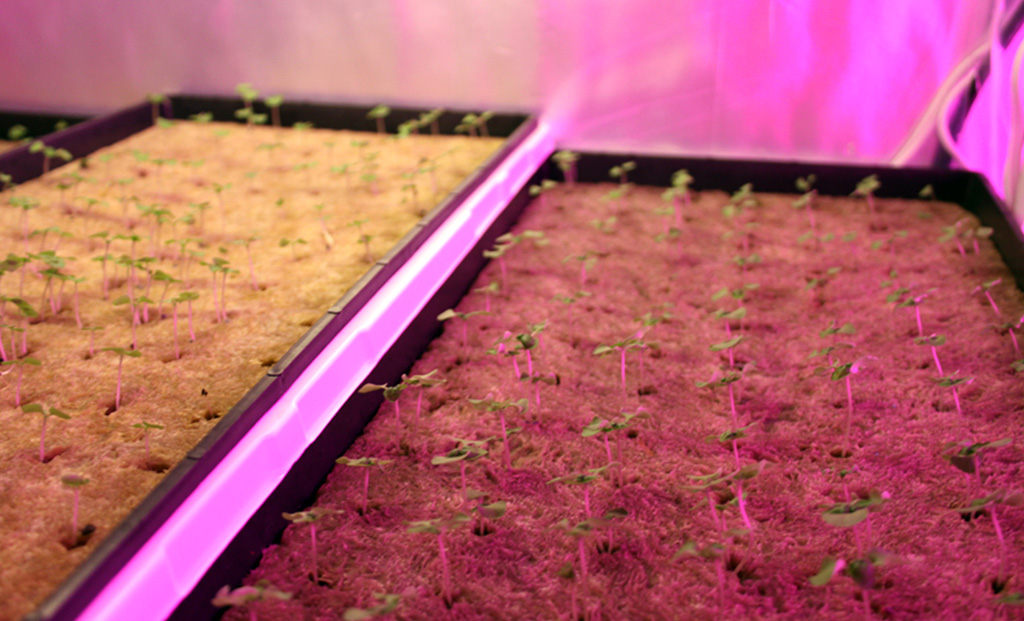
They retrofit used shipping containers into little modular farms that can be strategically placed to supply the needs of communities.
By employing a vertical farming system, they can maximize the the growing space within the container and is possible have year-round growing season. This system brings a high volume of fresh, quality and affordable food within reach of everyone along the food supply chain.
The Freight Farms method uses less water and energy than traditional farming methods and can be done without pesticides or herbicides.

 
Freight Farms offer an immediate foundation to grow a local food economy and sustainable food system.
By enabling high-yield crop production in any climate, Freight Farms offer an immediate foundation to grow a local food economy and sustainable food system.

More info
website Freight Farms

Photo credit © Freight Farms


4 mar 2013

Afghan Dreamers, a project book to break stereotype on a country


Afghanistan is probably best known in the world for its poverty, destruction, terrorism and oppression. But Afghanistan is not just a ongoing conflict. We are all half blind by the influence of the world of mass media, seeing only one part of a story. Against this backdrop, are the dreamers and visionaries. Artists, musicians, innovators, activists, media moguls, and politicians. Just like any other country – the dreamers and the free thinkers are often those whose stories are quieter than the stories of violence and anger that shout more loudly. That doesn’t make them less powerful.

Afghan Dreamers is a book project that seeks to tell these stories; the ones that draw a different picture of Afghanistan. A picture that shows the innovation and inspiration that can be born out of destruction.
The book will bring together interviews with 20 plus Afghan innovators and dreamers, these include: the artist Shamsia Hassani, the musician and filmmaker Ariana Delwari, the mayor of Kabul Muhammad Yunus Nawandish, the bass player for District Unknown, Afghanistan's first metal band, Abdul Qasem Foushanji and much more...

the artist Shamsia Hassani
Afghan Dreamers is a partnership between Sharp Stuff, an independent publishing project, working on new ways of storytelling and engagement, and Mountain2Mountain, a burgeoning nonprofit organization. This is a project that amplifies the voice of these dreamers. Forty years of war may have destroyed much in this region, but these stories, these dreamers, show that it hasn’t destroyed the pride and spirit of Afghanistan.

What is very important is that they need your help to make this book project a reality. You can help amplify these voices and show the world that stereotypes need to be challenged and our eyes and ears need to be opened. You can support this project and be part of the story. It takes the global community to hear these stories, believe in the dreamers, because it is the dreamers that will change the world!

More info

Photo credit © Afghan Dreamers

the musician and filmmaker Ariana Delwari
the bass player for District Unknown


the mayor of Kabul Muhammad Yunus Nawandish


3 mar 2013

Sunday's Tale: Mandela Foods Cooperative take care of food system of West Oakland, California


Sunday's Tale: a post from the past
Just three days ago on Sustainable diary we wrote of the cool song FoodFight, by Earth Amplified and with today's story we really recognize how people need for being more conscious about our food and food systems.
Until a few years ago West Oakland, a neighborhood situated in the northwestern corner of Oakland - California, had 53 liquor stores and no grocery stores at all. The community had the nearest supermarket, with a full produce section, at one hour's walk away.

In the video we can see James Berk, a local inhabitant, explain that for this lack is diet used to consist of Fritos, Cheetos, and Doritos, and not much more.
But in june 2009 with the opening of Mandela Foods Cooperative the thing started to change. It is a worker owned grocery store (Berk is became one of them!) and nutrition education center that brings healthy, local produce to the neighborhood, and even delivers healthy food to local corner stores. 


Mandela Foods Cooperative is one component of Mandela Marketplace's FoodEnterprise Network that builds a local food system and entrepreneurship opportunity for residents in West Oakland, and establishes a model to catalyze a local food economy within the inner-city.
They purchase from and support small scale farmers, local and cooperative businesses, non-GMO growers, organic producers and fair trade organizations. They carry an array of pesticide free, organic whole foods and grocery items.
So if food kill more people then guns for the moment the situation here is save.

More info

Photo credit © Mandela Foods Cooperative


1 mar 2013

The only hotel in the world without rooms: Faktum Hotel


Today we want to tell the story Faktum Hotel, the only hotel in the world without rooms. It is located in Gothenburg, the second largest city in Sweden. With just $ 10 you can book a night in one of 10 different places at your disposal: a forest, an abandoned building, a park bench. These are all en-plein-air, so you can try to sleep as a homeless man.
A description of the hotel's "rooms" tells you everything you need to know: "A stay at the Skeppsbron wharf assures you a waterside vista in the heart of the city."


One of every six homeless people in Sweden live in Gothenburg, they are 3.400 circa. Most of them find a roof over their heads with a friend or at a refuge, but some sleep in the open air.
The brainchild of Faktum magazine editor-in-chief Aaron Israelson, the hotel plans to give its profits to support the magazine's charity work, aimed at raising awareness of Sweden's homeless population. Aaron told: “We don’t think politicians do enough. This is a reminder of poverty and a way to get involved in an easy manner."

There are a tonne of ways to think about Charity Campaigns, but this one is just a tad different.
There have been about 1,000 bookings so far. You can book one for yourself, or as a gift for somebody else. Either way the money goes to the work for homeless and socially vulnerable people.

More info
website Faktum Hotel

Photo credit © Håkan Ludwigson - Faktum Hotel


Twitter Delicious Facebook Digg Stumbleupon Favorites More