Visualizzazione post con etichetta Public spaces. Mostra tutti i post

14 mar 2013

Waiting for the spring: Ecology of Colour Pavilion in Kent, UK


UK-based Studio Wave created Ecology of Colour, a colourful pavilion for holding a variety of sustainable craft workshops within Dartford Central Park’s Ecology Island. This is the third Artlands public realm commission for North Kent. Made from local materials, was designed “to act as a jolly custodian" and encourage community involvement in a neglected corner of a public park.

In response to this unique context, Studio Weave have designed a small versatile structure with a semi-outdoor space at ground level and an enclosed area on the first floor with many windows that open wide onto the landscape. As well for bird watching and art studio the building will be used as an outdoor classroom, a dyeing workshop and simply as a rain shelter, as well as sun shelter, within the Ecology Island.


The colorful cladding was conceived by graphic studio Nous Vous who have created a cohesive graphic visual language for the exterior of the building. Prior to its installation, a team of local residents and artists worked together in a painting workshop to produce each of the 144 panels, which form the external cladding.
The building opened in September 2012, now a group of designers is working with a group of horticulturists to create a garden full of native plants for extracting natural pigments (including Golden Rod for yellow, Alder for red and Bugloss for blue), celebrating nature and color in a fun, inclusive way.

More info
website Studio Weave
facebook page

Photo credit © Studio Weave


13 mar 2013

The most beautiful, and green, street in the world: Rua Goncalo de Carvalho


Sustainable diary has found another amazing green tunnel, so let's go in Brasil.
RuaGoncalo de Carvalho is a street located in bairro Independência in the city of Porto Alegre, the capital of the state of Rio Grande do Sul. Flanked by trees on either side, the street became internationally known after a campaign for its preservation spread on the Internet leading it to be dubbed "the most beautiful street in the world", and today it is considered "environmental heritage" by the city.
It is a forest. Over a span of 500 meters the sidewalks are lined with more than one hundred trees of the genus Tipuana, going up to the seventh floor of the buildings in some cases. These trees were planted in the 1930s by employees of German origin who worked in a local brewery.

In 2005, the construction of a mall nearby brought the risk of changes to this beautiful street, prompting residents to mobilize. The campaign was successful, and on June 5, 2006 the then mayor José Fogaça signed a decree making the street Gonçalo de Carvalho "historical, cultural and environmental development of the city."


The writer Pedro Nuno Teixeira Santos wrote: "Goncalo de Carvalho in Porto Alegre, Brazil, is not only the most beautiful street in the world because of the stunning visual effect of its immense Tipuana green tunnel. It is the most beautiful street in the world for this, but mainly because these trees were planted cherished by its residents, over several decades, that is, the green tunnel is the result of love, the love of the trees! It was from this love and this struggle of the residents of Goncalo de Carvalho, that the political power of the city found itself forced to recognize the importance of cultural heritage, landscape and environment, classifying and protecting it with the force of law".

More info

Photo credit © here


26 feb 2013

Bring butterflies back into the city, with Ettore Favini


Today, until Friday 5 April 2013, the Pastificio Cerere Foundation in Rome will present the exhibition project by Ettore Favini Verdecuratoda…voi (which forms part of the vaster project Verdecuratoda begun in 2005) curated by Marcello Smarrelli.
Favini’s research explores man’s relationship to nature and time, reading the social context in all of its complexity. For this new project, the artist rereads the subject of ecology from a contemporary perspective, involving spectators in a “game” that binds them to an act of responsibility toward themselves and the environment.

Verdecuratoda…voi, presents an opportunity to trigger a real environmental metamorphosis. In addition to prompting the urban forestation of green species, this phase of the project aims to bring butterflies back into the city, thus restoring an important marker of air quality to urban areas.
The show is structured around several intercommunicating devices.
The space will contain a vending-sculpture from which attendees will be able to withdraw, using a €1 coin, spheres containing the seeds of plants, bushes and flowers useful to the sustenance and reproduction of butterflies. Users will have the opportunity to become actively involved in the artistic process by following the instructions contained inside the spheres, and planting the seeds. The aim is to build the world’s largest vegetable sculpture. This intervention the first in a series of similar events that will be organized across a number of countries.
In the courtyard, the artist will build a display using the various plant species whose seeds are contained in the vending-sculpture spheres.

 
The ex-silos space will feature a projection of La Verde Utopia, a conversation between Ettore Favini, Alessandra Sandrolini and Gilles Clément – gardener, landscapist, theorist of the Third Landscape and the Plantary Garden, and supporter of biodiversity. This video addresses the main issues at the heart of Clément’s research: from the analysis of diversity in economic, ecological and social terms, to his project for a “realizable” utopia.

The project further anticipates the launch of a website where participants will be able to point out the exact location of the seeds they have planted, and upload the photos of the plants, thus contributing to the mapping of the vegetable sculpture.
In addition to purchasing seeds, participants will also be able to contribute to the development of the project by making a donation to the Banca Etica, in return for which they will receive a limited edition object created by the artist in collaboration with Canedicoda.


At the inauguration of the project will be presented in collaboration with the Roman study of architecture IaN +, invited by Emilia Giorgi, has designed the concept for the vending machines that will be located in the following areas of institutions, foundations, museums interested in joining the initiative Verdecuratoda.

An individual action can produce substantial changes only if it is repeated countless times, while countless micro-changes on a local scale can, if united, give life to large-scale transformation.
It would be great that the next spring, Rome is invaded by clouds of butterflies!

More info
website Ettore Favini

Photo credit © Ettore Favini


22 feb 2013

10-meter high of Plastic Bags, by Pascale Marthine Tayou


The installation Plastic Bags occupies since last spring, the Hall of the historic part of the MACRO - the Museum of Contemporary Art of Rome, interacting with the Odile Decq's architecture. This is the space for free passage of MACRO, which is used by the locals to move from one street to another district, just like a square from the global village.

Plastic Bags is a large installation shaped like a giant beehive, almost ten meters high by the Cameroon artist Pascale Marthine Tayou. It is made entirely from plastic bags that evoke in their simplicity, the many stories of our daily lives. They offers a colorful critique of capitalism, consumerism and widespread plastic pollution.
Everyday objects, useful as insidious, the bags have become a symbol of the growing globalization and consumerism, but also homelessness that increasingly characterizes today's society, a central theme in the artist's research.
But the journey of these plastic bags was long. In 2012 the installation was realized at gare de Paris Saint Lazare with the collaboration of the people. The work was in 2011 in Milan at Hangar Bicocca for the group exhibition "Terre Vulnerabili", and even before at Queensland Art Gallery of Brisbane, in Australia.

The common denominator of his work is the idea of travel, not only physical but also mental, that manifests itself as an ongoing cultural and geographic displacement also in the choice of materials (waste and rubble urban or everyday objects often coming from the place where he is to work). The traveler for the artist is not only a way of life, but also a psychological condition, meeting with something else, able to subvert the social, the political, economic and symbolic of our life: "It is a certainty that traveling is the hope of meeting the magic that hides the mysteries of the rational human being."

Plastic Bags will be on exhibit at Macro through April 1, 2013.

More info
website MACRO

Photo credit © Giorgio Benni/MACRO


21 feb 2013

Urban agriculture on ship in Antwerp, by art collective Time Circus


In this day of snow in Milan, is back again to talk about urban garden, this time the project enters (or leaving?) directly from the art world.
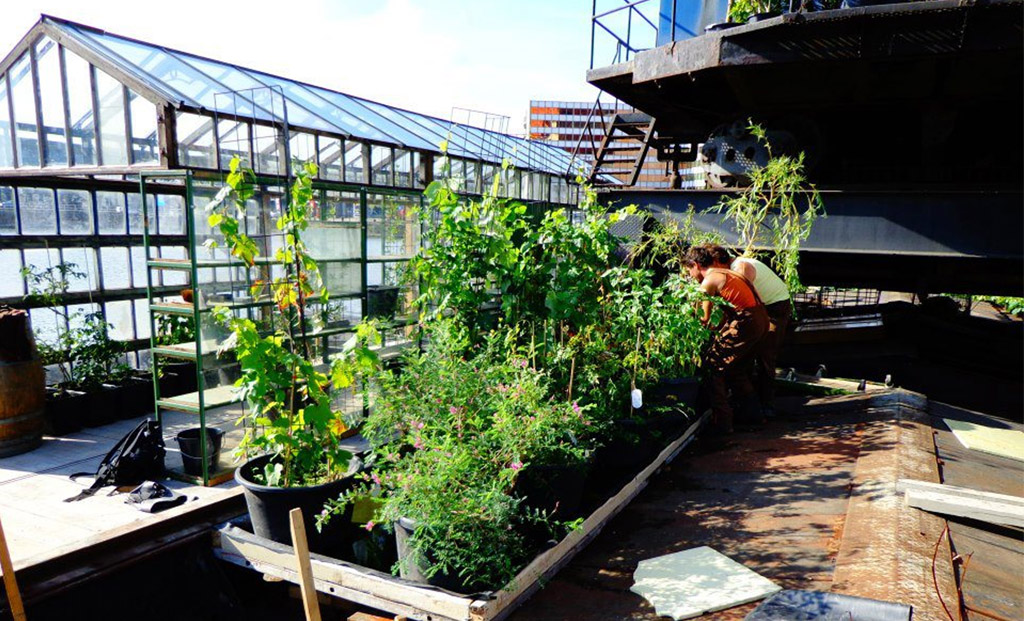
We know that urban gardens can bloom in the weirdest of places, also on an old unused ship crane docked at Bonapartedok, the Belgian port city of Antwerp. Here the Belgian art collective Time Circus, built their great green space, and outfitted with a tree-house made out of recycled materials and a chicken coop. Another cute feature from the floating garden is a glazed greenhouse.


Commissioned by the Antwerp’s MAS Museum, the floating Welvaert Welton garden is designed to engage locals and visitors with sustainable urban farming practices, through community workshops on composting and homemade cider parties. Not only is there a vegetable garden, there's also a kitchen where food can be prepared using ingredients straight from the garden. Urban agriculture is not just about producing one’s own vegetables but more about creating an urban living, working and meeting place.

This experimental garden project is temporary, intended to go on until 2014. It is one cool example of taking back abandoned city spaces, and they can become green and productive.
Time Circus said that is ready to travel to far off places to spread the idea...

More info

Photo credit © Time Circus


19 feb 2013

UFU (Urban Farming Unit) by Damien Chivialle, for re-thinking cities


Yesterday on the diary there was the fabulous story of Todmorden, a town in UK where inhabitants grow in the green public area almost all the vegetables that need. Today we write on another project of re-thinking cities, food production and consumption, UFU (UrbanFarming Unit) a solution for who that don't have a adapted places and conditions.

UFU is a farming experiment inside shipping containers created by French designer Damien Chivialle. Organic fish, fruits and vegetables are produced in the street, avoiding unnecessary travels and providing meaning to food consumption in downtown cities. All prototypes are based on circular agriculture techniques.
Normally, such a container is found in industry, but with UFU it is used to test new applications in a city context. Cycle cultures are central in the research on biological farming without land. Objectives of UFU are to find solutions for growing food under polluted and reduced ground.


Damien Chivialle places a greenery on top of a container in which a aquarium with fish is housed. The fish’s water and excrements feed the greenery plants, who in turn purify the water that flows back to the aquarium. The result: UFU (Urban Farming Unit), a self-regulating city farm the size of a parking spot.
2011’s UFU is one of many container projects in Paris, Lissabon and Zürich, and was recently shown at Brussels’ Kaaitheater. Now, until the end of February, UFU is exhibit in On Leuven’s Grote Markt as part of the Artefact Festival program

The last amazing thing is that this project is developed as Open Source. Download the Sketchup 3D model to make your own greenhouse >>go here

More info

photo credit courtesy Urban Farm Units


18 feb 2013

Incredible Edible in Todmorden: the town that grows all its vegetables


In England, in the county of West Yorkshire there is a small town whose people decided they were worried about climate change, food security in Africa and their children's future . It is Todmorden, a town of 14.000 inhabitants, which in 2008 started what has become the "Incredible Edible" movement.

They started growing vegetables and herbs in flower beds, the aims are to make use of 
underused areas of the community and public spaces to grow food for all to eat. The people wants “to get closer to the food we eat, education and community involvement”.
Their growing around town is organized by their community growers’ group, they are all volunteers. Most of their growing around town is done in raised beds. That means they can use fresh uncontaminated soil and avoid messing surrounding areas. Many of the beds are adopted by groups of people, who do much of the planting and maintenance themselves and may benefit from the produce too. But what is very important is: gifts from the garden to the public is allowed free access.


Last year in Todmorden were counted 70 green areas turned into urban gardens. Along the streets of the town there are plenty of fruit trees, that in the right seasons offer cherries and apricots. They are also bushes with blackberries and strawberries and the point where you can collect legumes, including beans and peas.
The project to make Todmorden the first self-sufficient city of England is expected to reach its peak in 2018.

Today there are nearly 40 independent groups across the UK and more than hundred globally flying the Incredible Edible flag. For this motive they have realize new website, due for for formal launch in April, aims to bring together all the wondrous people who have taken on the "Incredible Edible" framework across the world, as well as to inspire new members.

More info:

photo credit: courtesy of Incredible Edible


17 feb 2013

Sunday's Tale - Nature integration into urban culture: Flower cushion in Bucheon City, Korea


Sunday's Tale: a post from the past
"Flower cushion" was presented in October 2012 after 2 months of work, for "Artistic Factory", a public art project by Kyonggi Art Foundation. It was initially planned as two separate commissions, one by seoul-based interdisciplinary artist Jeong Hwa Choi and the other by Korean architecture Mass Studies but, following the site visit, both decided to collaborate on single project to have a stronger impact with relatively small means.

"Flower Cushion" is located at the Piloti space at block 1 of Technopark, in Bucheon City, Korea. The existing Piloti space with an high ceiling was not well used despite of its generous size and prominent location in this highrise factory block. Therefore, they propose a gathering space that accommodates factory workers' various activities such as resting, meeting and outdoor performances, etc. At the same time, it works as a pedestal for the Choi's sculpture "You are Flower" that was created from recycled monochromatic hardware part, continuing a series of floral-form works that use the artifacts of everyday life and Korean kitsch to honor the intangible beauty of nature while understanding it's variously successful integration into urban culture.


"Flower Cushion" rises above ground, as if the blossoming of Choi's flower created the eruption. This small hill like eruption follows the existing pavement's checkerboard pattern and colors which are made of typical interlocking cement paving blocks. These "cushions" rise around the flower sculpture in an elliptical concentric form that covers around 10m X 7m in plan and 1.2m in height. The height of each "Flower Cushion" provides optimum seating conditions with various height and viewing directions. While maintaining the same colors and shape as existing cement blocks, the material for "Flower Cushion" is made of rubber chips in order to accommodate a comfortable seating condition, also they calling attention to the over-saturation of consumable and ultimately disposable objects in the digital age.

More info:

Photo credit Kyungsub Shin, draws from Mass Studies


16 feb 2013

Upcycled Playground in Malawi's hospital by Sakaramenta


Sakaramenta is a social enterprise producing push and bicycle carts.
It is based in Blantyre, Malawi, and founded in 2009. Sakaramenta produces 5 different carts to transport patients, goods and other supplies behind the bicycle. The bicycle cars are designed according to high Dutch quality standards, at the moment 21 people are employed.

The reason to start up this business, is a believe in creating employment, stimulating entrepreneurship and local production in the best of way of bringing development to a country.
Getting things from A to B is not always easy in Malawi. The weather, shortage of fuel and quality of roads make carrying goods and people a though job. Sakaramenta takes the challenge to solve these problems.
Furthermore they make play ground, school and hospital equipment. Like glides, swings, school desks, trolleys. The focus point are: simple, strong and sustainable. All the parts can be maintained locally. Them workshop is in Blantyre, experienced and well educated staff are making high quality products.


The last project is born from an idea by Peter Meijer, founder and managing director of Sakaramenta. He has created a kids' playground on the site of a local hospital.
The simply wonderful intervention considers its site, introducing a scrapped ambulance, repurposing it as a playground clubhouse, with an integrated - where children patients (and grown-ups) can play having a fun together. Independent research concludes that playgrounds are among the most important environments for children outside the home. Most forms of play are essential for healthy development, but free, spontaneous play—the kind that occurs on playgrounds—is the most beneficial type of play.

More info

photo credit Sakaramenta


Twitter Delicious Facebook Digg Stumbleupon Favorites More